by

Has a tenant ever asked you: "My report has been in for three days — why haven't I heard anything?" If your answer depends on who you ask and what day it is, your building probably doesn't have an SLA. A service level agreement for building maintenance — commonly shortened to SLA — is a document that sets the promised service standard, how it is measured, and the consequences of missing it.
SLA is not a new concept. The IT and professional services worlds have used it for decades, and quality management frameworks like ISO 9001 emphasize measurable service targets. Yet in building management, an SLA is still often treated as "just a vendor contract document" — even though its benefits go much further.
What Is a Service Level Agreement for Buildings?
In simple terms, an SLA is a written agreement about what will be served, how fast, and how success is measured. In a building context, SLAs can exist at three different levels:
- Internal SLA — between building management and its own operations team (e.g., AC complaints must be acknowledged within 2 working hours).
- Vendor SLA — between the building and its maintenance contractor, cleaning service, or security provider (e.g., a technician must arrive on-site within 4 hours of a report).
- Tenant-facing SLA — service standards published to tenants (e.g., all emergency reports acknowledged within 15 minutes, 24/7).
Key Components of a Building SLA
A good SLA contains at least five elements:
| Component | Explanation | Example |
|---|---|---|
| Scope | Which services are covered | AC repair, plumbing, electrical |
| Response time | How fast the team acknowledges | 2 working hours for normal tickets |
| Resolution time | How fast the issue must be fixed | Maximum 48 hours |
| Service hours | When the SLA applies | 24/7 for emergencies; Mon–Fri for general |
| Measurement method | Where the data comes from | Ticket system, not staff memory |
Important note: response time and resolution time are two different things. Fast acknowledgment with slow resolution still disappoints tenants — and it happens often because teams focus on "replying first" without chasing the actual fix.
A Real-World SLA Example for Maintenance Teams
An office building set an internal SLA: emergency pipe-leak reports must be acknowledged within 15 minutes and handled by a technician on-site within 1 hour. Everything was recorded in a ticket system, and the manager reviewed SLA compliance monthly.
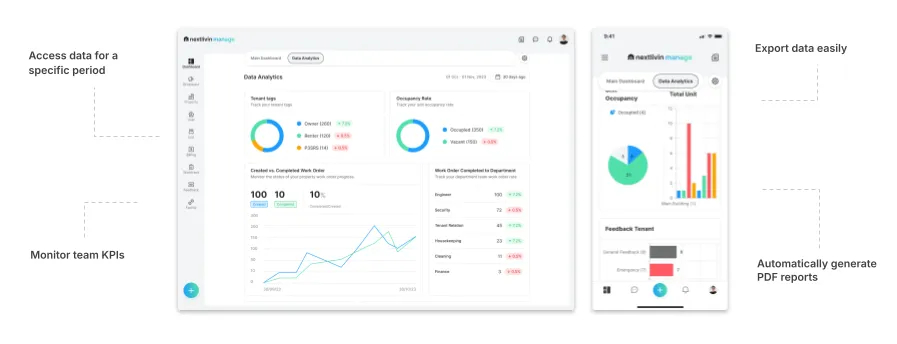
The results were telling: in month one, compliance was only 61%. But not because the team was lazy — 80% of delays occurred on night and weekend shifts, when only a skeleton crew was on duty. The fix was not blame; it was adding an on-call rotation and re-agreeing priorities. Two months later, the number climbed to 89%.
That is the point of an SLA: it turns vague complaints into data that can be improved.
Common Mistakes When Writing SLAs
- Setting targets without a baseline. Writing "resolved within 1 hour" without knowing actual conditions produces a document that fails from day one. Measure first, then set progressive targets.
- Being too rigid. SLAs need clear exceptions (force majeure, tenant-caused delays, spare-part availability).
- Write it, then forget it. An SLA that isn't reviewed quarterly stops being relevant within six months.
An SLA Is an Evaluation Tool, Not a Filing-Cabinet Document
The biggest mistake is creating an SLA as an administrative requirement and then locking it in a drawer. Its real value lies in the cycle: set a target, measure, evaluate, improve. If your building already runs regular operations audits, an SLA is a natural companion — the audit shows your condition, the SLA shows your standard, and the gap between them is your to-do list.
A good building is not measured by promises in a brochure, but by the consistency of service that can be proven with numbers. And an SLA is the simplest way to start proving it.