by

Industry Insight
In residential building management, billing systems are often one of the main challenges. Manual processes such as recording payments, sending invoices, and handling late payments are time-consuming and prone to errors.
In addition, the lack of transparency in billing systems can lead to tenant dissatisfaction. Delayed information, miscalculations, and miscommunication are common issues.
As technology continues to evolve, many property managers are shifting toward digital billing systems as a solution to improve efficiency and service quality.
Content
Digital billing serves as a modern solution to simplify the billing process in residential building management. With an integrated system, all processes can be handled automatically and centrally.
Managers no longer need to create invoices manually, as the system can generate bills automatically based on predefined billing cycles. Additionally, payment notifications can be sent automatically to tenants, reducing the risk of late payments.
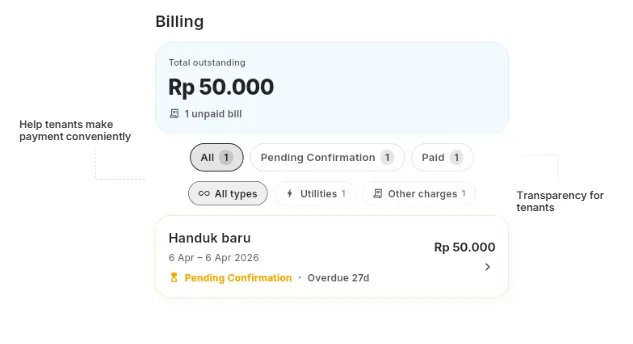
For tenants, this system provides convenience in making payments. They can view billing details transparently and complete payments through various digital methods.
Furthermore, managers can monitor payment status in real time, making it easier to manage finances and make informed decisions.
With digital billing, processes that were once complex and time-consuming become simpler, faster, and more accurate.

Feature Highlight
Here are some key advantages of digital billing in building management:
1. Automated Invoice Generation
Bills are created automatically based on predefined billing periods.
2. Payment Notifications
Automated reminders help reduce late payments.
3. Billing Transparency
Tenants can view detailed billing information clearly and in real time.
4. Payment Monitoring
Managers can track payment status instantly.
5. Operational Efficiency
Reduces manual work and improves data accuracy.
News Update
Digitalization in the property sector continues to grow, including in billing systems. Many building managers are adopting cloud-based technologies to improve efficiency and transparency.
In addition, integration with various digital payment methods has made transactions more convenient for tenants, aligning with the increasing adoption of cashless payments.
Looking ahead, digital billing systems are expected to evolve further with the support of technologies such as AI and data analytics, providing deeper insights for management.

Conclusion
Digital billing is an effective solution to address various challenges in residential building billing systems.
With automation, transparency, and ease of access, both managers and tenants can benefit significantly.
In the digital era, adopting modern billing systems is no longer just an advantage—it has become a necessity for creating more professional and efficient building management.

This Article is provided by Nextlivin, for more information about how Nextlivin can help manage your property efficiently, please kindly visit our site.