by EngageBay
Building Google reviews are likely being read by prospective tenants long before they ever contact your marketing or building management team. The problem is that most building managers never actually monitor what's written there.
Google reviews aren't just about the numeric rating. According to academic research on online review influence, more than 80% of consumers now read online reviews before making a decision. For office buildings or apartments, these reviews are often the first source of information a prospective tenant checks before ever reaching out to the marketing team directly.
Negative reviews are rarely about the building's design or location — they're almost always about the operational experience: slow complaint response, confusing parking systems, or a perceived lack of transparency. These are all things that are actually preventable on the operations side, not the physical building itself.
Most building management teams focus on handling complaints that come in through WhatsApp or in person, but rarely does anyone routinely monitor and respond to Google Maps reviews. Yet a review left unanswered signals that the complaint was never followed up on — not just to the one tenant who complained, but to everyone who reads that review afterward.
The cheapest first step: monitor reviews regularly and respond professionally, including to negative ones — not to argue, but to show the feedback was heard. The more fundamental step: make sure the root causes behind common complaints (slow response, unclear documentation) are actually fixed at the operational level, not just smoothed over in the review section.
A building with organized administration — for example, keeping essential building documents properly stored — is usually also better positioned to answer prospective tenant questions with confidence, since there's nothing to hide. A system like Nextlivin for Teams helps make sure complaints get genuinely resolved before they ever turn into a public negative review.
Schedule a free demo today!
📞 0818-958-899 🌐 www.nextlivin.com
Manual facility booking — meeting rooms, gyms, pools, function halls tracked via WhatsApp or a front-desk notebook — looks like a minor operational detail, but its impact on tenant experience is bigger than most buildings realize.
Two tenants book the same slot because records aren't updated in real time. The front desk forgets to log a booking while handling something else. Tenants have no way to check what's actually free without asking first. Each of these looks small on its own, but they add up to a perception that a building is "less professional" at managing the very amenities meant to be a selling point.
Shared amenities are often a key reason tenants choose — or stay in — a building. According to Colliers' Jakarta Office Market Report Q2 2026, modern tenants increasingly weigh operational efficiency and service flexibility, not just location and rent. A small friction point like a failed meeting room booking due to a scheduling conflict can quietly influence their decision to renew.
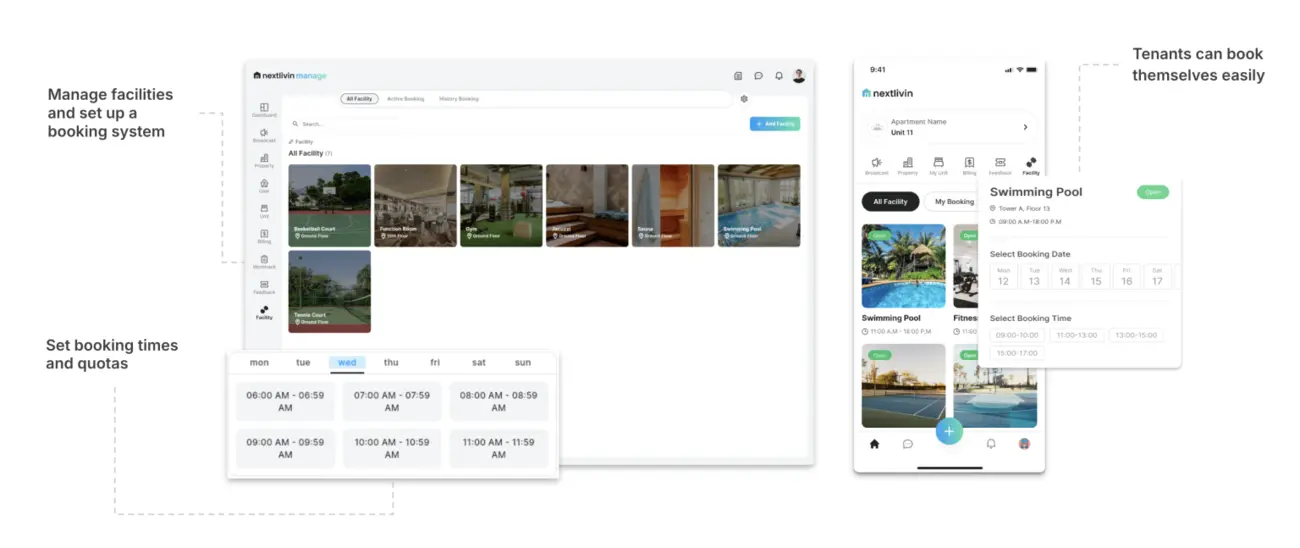
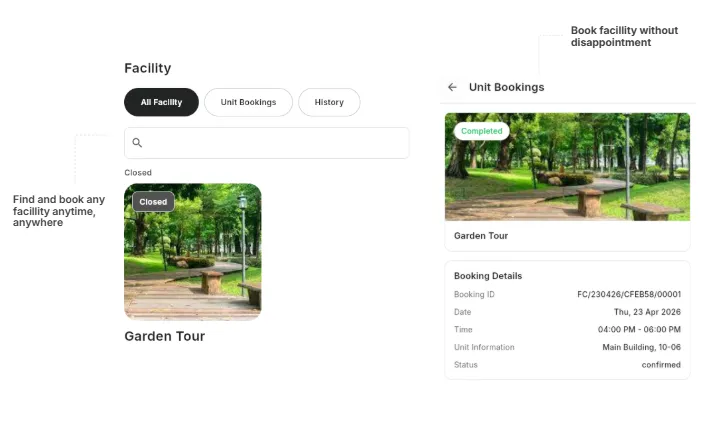
Facility booking managed through a digital system removes scheduling conflicts because availability is visible in real time to everyone. Tenants can book themselves through the app without waiting for a WhatsApp reply, and the building team gets usage data to guide future decisions. That's what Nextlivin for Tenants offers — tenants book independently, while the building team keeps full control over the schedule and availability.
If your building has already invested heavily in its amenities but still manages bookings manually, that investment isn't reaching tenants at its full value.
Want to see how facility booking can run without scheduling conflicts? Schedule a free demo today! 📞 0818-958-899 🌐 www.nextlivin.com
Modern tenant expectations toward property management have moved well beyond "clean and secure." According to Colliers' Jakarta Office Market Report Q2 2026, companies are increasingly relocating to buildings that offer operational efficiency, flexibility, and higher service quality — not just location and price. Here are five shifts worth preparing for.
A 24-hour response used to be considered reasonable. Today, tenants compare their experience against other digital services — e-commerce, ride-hailing — where response is near-instant. What used to feel acceptable now reads as neglect.
Tenants are no longer satisfied with "we're working on it." They want to know exactly where things stand — what stage it's at, when it'll be resolved. This is a shift from trust built on promises to trust built on visibility.
Today's tenants would rather report an issue, book a facility, or check a bill through an app than call or visit a management office. This isn't about chasing technology for its own sake — it's about a convenience standard set by every other service they use.
The same Colliers report notes that buildings prioritizing efficiency, flexibility, accessibility, and sustainability tend to recover faster than those relying solely on rent discounts. Corporate tenants are now genuinely factoring this into where they choose — and choose to stay.
Features like digital access, online facility booking, and automated notifications are now considered standard, not a premium extra — especially among corporate tenants and mid-to-upper market apartment residents.
These shifts align with the trend we cover in why building managers are switching to integrated software in 2026 — buildings that stick with manual processes will find it increasingly hard to meet these expectations. Giving tenants self-service access through an app, like Nextlivin for Tenants, is one of the most direct ways to answer this shift.
Schedule a free demo today!
📞 0818-958-899 🌐 www.nextlivin.com
Note: the following is a composite illustration based on patterns we commonly see in mid-sized buildings, not a case study of one specific client.
A building operations turnaround rarely starts with a big decision. More often, it starts with exhaustion — the same team answering the same questions over and over without ever solving the root cause.
Picture a mid-sized apartment building with around 300 units. Tenant reports come in through WhatsApp, phone calls, and sometimes a note left at the front desk. There's no single place that holds the status of all of it. The building manager spends most of their time not solving problems, but figuring out "which report is this, has it been handled, who's on it."
This pattern is extremely common — and according to Colliers' Jakarta Office Market Report Q2 2026, buildings that fail to modernize their operations tend to lose ground on tenant retention, since tenants now weigh management quality just as heavily as location and rent.
Instead of digitizing everything at once, the first move was standardizing the single most problematic process: handling maintenance reports. Every incoming report automatically got a status, a clear owner, and a follow-up deadline — the same approach we outline in our 30-minute operations audit.
The change wasn't just in resolution speed — it was in perception. A tenant who knows their report is actively being worked on, rather than vanishing into a void, is far more patient than one who has to keep asking for updates. Trust grew not because every issue got solved instantly, but because the process became visible.
The core lesson: an operations turnaround doesn't need to start with a complete system. Start with the one process generating the most repeat questions, standardize that first, then expand from there. Nextlivin's Worktrack feature is built for exactly this starting point — giving every report a clear status and owner without requiring you to digitize everything at once.
Schedule a free demo today!
📞 0818-958-899 🌐 www.nextlivin.com
Late tenant payments are one of the most common headaches for property managers, and how you handle them matters as much as whether you handle them at all. Push too hard, and you risk the relationship. Stay too lenient, and your building's cash flow suffers. The good news is there's a staged approach that stays firm while keeping the relationship intact.
Before jumping to collection tactics, it helps to understand the root cause. Most delays aren't about unwillingness to pay — they're about:
Understanding these causes helps you pick the right response instead of jumping straight to aggressive collection.
1. Automated reminders before the due date. Send a reminder 3-5 days before payment is due, not after it's overdue. This alone prevents many cases that are really just about forgetting.
2. Personal outreach the moment it's overdue. Once the due date passes, reach out directly — WhatsApp or a call — with a questioning tone rather than an accusatory one: "is everything okay with this month's bill?" This opens dialogue and often resolves the issue on the spot.
3. Offer a real option when there's a genuine hardship. If a tenant is genuinely struggling, a short installment plan is far better than letting the balance sit unresolved.
4. Escalate formally only after repeated non-response. If several attempts at communication go nowhere, move to a formal notice following your building's SOP.
In Indonesia, the obligation for unit owners and residents to pay shared management fees is grounded in Law No. 20 of 2011 on Rumah Susun (Strata Title Buildings), which governs the role of PPPSRS (the owners' and residents' association) in managing shared fees. Understanding this legal basis keeps your collection process within proper boundaries, rather than relying purely on unilateral building policy.
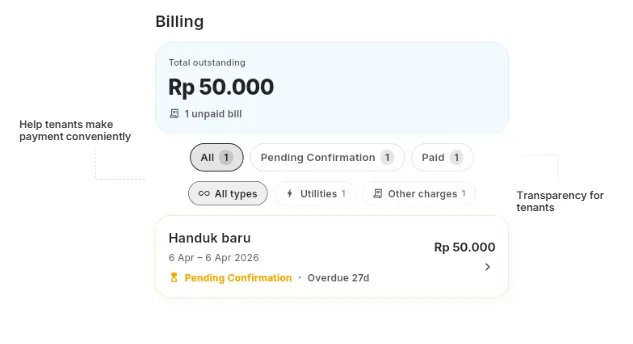
The most effective long-term fix is reducing the reasons tenants fall behind in the first place — not just improving how you collect. That starts with accurate billing data from day one (see our guide on reconciling IPL and tenant bills) and giving tenants easy access to check their own payment status through Nextlivin's Billing feature, so "I didn't know I had a bill" is no longer a valid excuse.
Firm collection and a good relationship aren't mutually exclusive — the difference comes down to clear communication and a transparent process from the start.
Schedule a free demo today!
📞 0818-958-899 🌐 www.nextlivin.com
Property teams need data to provide services, but data that is excessive or stored without clear controls can create problems for both tenants and staff. Common examples include visitor lists in group chats, identity photos on personal phones, former residents still marked as active, or broadcasts sent to irrelevant recipients. A tenant data checklist for property managers helps teams separate necessary information from extra data. A tenant data checklist for tenant data property managers helps teams separate necessary information from extra data.
A practical first step is not necessarily buying a new system. Build an inventory: what data is collected, why it is needed, who owns the process, who may access it, and when it should be reviewed.
| Data type | Source | Purpose | Owner | Access | Location | Review point |
|---|---|---|---|---|---|---|
| Unit and tenant | Registration form | Unit service and communication | Admin/tenant relations | By role | Primary record | When changed |
| Visitor | Front desk/security | Access control | Security supervisor | Authorized staff | Visitor log | Per policy |
| Package | Courier/front desk | Item handover | Front desk | Relevant staff | Package log | When completed |
| Feedback and billing | Tenant/app/finance | Service and reconciliation | Team lead | Role-based | Relevant system | Regular review |

Security staff do not need to see all billing information. Finance does not need every visitor record. Tenant relations may need contact details and service history, but not every internal document. Role-based access reduces accidental sharing and makes ownership clearer.
The UU Nomor 27 Tahun 2022 tentang Pelindungan Data Pribadi defines Personal Data and distinguishes the Personal Data Controller, Personal Data Processor, and Data Subject. This article is operational guidance, not legal advice. Review internal policies, tenant and vendor agreements, and organizational requirements; seek legal advice when a specific assessment is needed.
User, Visitor, Package, Feedback, Broadcast, and role-based permission capabilities in the Nextlivin features can support a more orderly process. Nextlivin Team connects team work and history, while Nextlivin Tenant can support self-service and more transparent tenant communication. The point is not to claim automatic legal compliance, but to make purpose, access, and changes easier to trace.
Audit five data sources this week. Choose the data that is most often wrong, assign its process owner, and create a clear update rule that every shift can follow.
Schedule a free demo today! 📞 0818-958-899 🌐 www.nextlivin.com
Visitors and packages may look like small administrative tasks, but they often create questions: who arrived, was the tenant notified, when was the package received, and who accepted it? When every shift uses a different method, information takes longer to find and proof is easily lost. An apartment visitor and package SOP helps every shift follow the same steps and evidence requirements.

| Item | What to check |
|---|---|
| Uncollected packages | Reference, location, receipt time, and tenant notification status |
| Visitors still on site | Destination unit, entry time, and approval status |
| Special access | Cards, vendor permits, or areas needing attention |
| Special conditions | Damaged package, incomplete address, or incident requiring escalation |
A visitor form does not have to store every identity detail if the process does not need it. Define the purpose, who may access it, and when the data should be reviewed. The same principle applies to package photos and handover proof.
Visitor, Package, Broadcast, User, and permission capabilities in the Nextlivin features can support one operating flow. Nextlivin Team helps staff see status and history, while Nextlivin Tenant can be used as a tenant notification channel. Consult PP Nomor 16 Tahun 2021 tentang Bangunan Gedung for the official building-management context, then adapt the SOP to the property’s house rules, security policy, and emergency procedures.
Test the SOP with one shift first. Record packages with unclear status, visitors without an exit time, and information that still has to be found in group chats. Those three findings become the first improvement priorities.
Schedule a free demo today! 📞 0818-958-899 🌐 www.nextlivin.com
A clean lobby and complete facilities create a strong first impression. However, the tenant experience is usually shaped by smaller moments: whether move-in information is clear, whether bills are easy to understand, whether an air-conditioning report receives an update, and whether a delivered package can be found without repeated questions.
If management measures the tenant experience only by complaint volume, many important moments will be missed. A tenant who does not submit a complaint is not necessarily satisfied. They may choose to remain silent, decide not to renew, or share a poor experience with another prospective resident.
This is where a tenant journey map is useful. A tenant journey map describes the stages of a tenant’s interaction with a property, their needs at each stage, potential friction, and the service evidence that should be available.
The map does not have to be complicated. You can start in one hour by choosing eight key moments, speaking with several tenants, and comparing their answers with operational data.

For every moment, record at least five elements:
Moment
Expectation
Friction
Service evidence
Process owner
This format helps the team see the tenant experience from a service perspective rather than only from the perspective of internal departments.
The tenant journey starts before a form is completed or a deposit is paid. Prospective tenants want to know the location, rent, facilities, house rules, transport access, visitor policy, parking, and who to contact when they need help.
For boarding-house and apartment owners, this stage is an opportunity to communicate consistently. A prospective tenant should not receive different answers from marketing, an agent, an administrator, and the building manager.
Simple audit: List the ten questions most frequently asked by prospective tenants. Check whether the answers are available on one page, in a digital brochure, or through an easy-to-access communication channel.
After a tenant agrees to take a unit, friction often appears in administration. The tenant may need to send documents repeatedly, wait for payment confirmation, ask about key handover, or request the building rules again.
Create a pre-move-in checklist covering documents, schedule, deposit, access, emergency contacts, renovation rules, and package procedures. Give the checklist one PIC and a clear status.
Service evidence: Unit confirmation, move-in schedule, received-document list, and access instructions.
The first day is a sensitive moment. A small defect, an inactive access card, a non-working Wi-Fi connection, or unclear parking information can shape the tenant’s perception of management quality.
Carry out a handover inspection that records the unit condition, meter readings, keys, access cards, inventory, and photos. For a boarding house, the format can be simpler, but the principle is the same: both parties should have a clear record of the starting condition.
Audit question: If a tenant reports damage on the first day, who receives the report, how is its priority determined, and when does the tenant receive an update?
Payment is one of the moments most likely to create discomfort. Tenants want to know the amount, billing period, cost components, due date, payment method, and payment status after they have paid.
Unclear information can make tenants contact the administrator repeatedly. Use a consistent billing format and provide payment evidence that can be found again easily.
For apartments, explain the difference between rent, IPL, utilities, penalties if applicable, and additional service charges according to the property’s policy. Avoid using “monthly bill” for every component if that makes it difficult for tenants to understand where the amount came from.
Service evidence: Invoice, payment status, transaction history, and a support channel for questions.
Tenants do not expect every problem to be solved within minutes. They need certainty that the report has been received, understood, assigned to a PIC, and is being handled.
A useful report form asks for the minimum information needed: location, problem type, time of incident, impact on activity, photo or video when necessary, and times when a technician can visit. After receiving the report, send a reference number and process status.
A good complaint process should be easy to use, responsive to the complainant’s needs, analyzed for patterns, and reviewed regularly. This is consistent with the guidance in ISO 10002:2018 on complaints handling in organizations, although the implementation should be adapted to the property’s policy and scale.
Service evidence: Report number, PIC, status, next-update target, work result, and tenant confirmation.
Gyms, swimming pools, multipurpose rooms, sports courts, and co-working areas can be important parts of the living experience. Friction usually appears when schedules are not visible, usage rules are unclear, or tenants do not receive booking confirmation.
Map the full process: viewing availability, choosing a time, reading the rules, making a booking, receiving confirmation, using the facility, and cancelling. Make sure tenants know what happens if they are late, do not attend, or exceed the time limit.
Service evidence: Availability schedule, booking confirmation, usage rules, and usage history.
For many tenants, comfort depends not only on the unit but also on how the property handles visitors and packages. A highly manual process can force tenants to call security, wait in the lobby, or struggle to find a delivered package.
Define a process that is secure and easy to understand. Tenants should know how to register a visitor, how staff verify access, when notifications are sent, and how packages are recorded and collected.
Service evidence: Visitor notification, approval status, arrival time, package notification, and handover history.
Many operators communicate with tenants only when the lease is about to end. Conversations about satisfaction and tenant needs should start earlier.
Ask what is working well, what problems keep recurring, which features are most useful, and what would make the tenant stay longer. When a tenant moves out, use exit feedback to identify issues that may never have been submitted as an official complaint.
Service evidence: Renewal reminder, obligation summary, inspection schedule, deposit-return process according to policy, and feedback record.
Use the following example as a starting point. Adapt it to the property type and internal rules.
Move-in
Tenant expectation: A clear and timely process
Friction to investigate: Schedule or access is uncertain
PIC: Admin/BM
Service evidence: Checklist and confirmation
First bill
Tenant expectation: Easy-to-understand breakdown
Friction to investigate: Cost components are confusing
PIC: Billing/Admin
Service evidence: Invoice and history
Damage report
Tenant expectation: Report is received and followed up
Friction to investigate: Tenant does not know the status
PIC: Tenant relations/Engineering
Service evidence: Report number and status
Facility booking
Tenant expectation: Schedule is visible and conflict-free
Friction to investigate: Double booking
PIC: Facility/BM
Service evidence: Booking confirmation
Package collection
Tenant expectation: Fast and secure notification
Friction to investigate: Package is difficult to track
PIC: Reception/Security
Service evidence: Package history
Renewal
Tenant expectation: Clear options and information
Friction to investigate: Management contacts tenant too late
PIC: Admin/Leasing
Service evidence: Reminder and feedback
On day one, choose one tenant type and define the eight moments you want to map. On days two and three, conduct short interviews with three to five tenants and two operational team members. Do not ask only, “Are you satisfied?” Ask when they last had to repeat a question, wait for an update, or look for information across more than one channel.
On day four, compare the answers with complaint, billing, facility-booking, visitor, package, and work-order data. On day five, mark frequent friction in red, friction without a PIC in yellow, and processes with clear service evidence in green.
On day six, choose one small improvement to test. Examples include sending a maintenance report number, creating a move-in checklist, or adding facility-booking confirmation. On day seven, measure whether repeated questions, response time, or incomplete reports have changed.
A tenant journey map becomes more accurate when tenant and team activities are recorded in a traceable workflow. Through Nextlivin Manage for Team, operators can connect work, reports, communication, and team follow-up in a more structured way.
The Nextlivin Features page also maps product capabilities across Data Management, Work Process, Reporting, and Tenant Experience. Connect features to the appropriate moment: Feedback for reports, Billing for charges, Facility for bookings, Broadcast for information, Visitor for guest access, and Package for delivery notifications.
The goal is not to insert every feature into every interaction. The goal is to help tenants understand what to do, receive updates, and find service evidence without repeating the same question.
The tenant experience is shaped by a series of moments, not by one facility or one conversation. A tenant journey map lets management see the process from the tenant’s perspective: what they expect, where friction occurs, who is responsible, and what service evidence should be available.
Start with eight simple moments, run a seven-day audit, and improve one friction point first. When Feedback, Billing, Facility, Broadcast, Visitor, Package, and Worktrack processes are more organized, operators have a stronger basis for building a consistent tenant experience.
Map one tenant journey this week, then compare the result with the Nextlivin Manage for Team workflow to see which part can be made more structured.
Want to create a more consistent tenant experience?
Jadwalkan demo gratis hari ini! 📞 0818-958-899 🌐 www.nextlivin.com
Picture yourself managing a 300-unit apartment building. Every morning, your WhatsApp is flooded with messages from residents: someone asking about this month's water bill, someone complaining that their air conditioner has been leaking for three days with no response, someone asking how to book the meeting room on the ground floor, and one furious tenant claiming their package has "disappeared" — even though the front desk actually handed it over two days ago, just with no record of it anywhere. All of this happens before 9 a.m. If this scenario sounds painfully familiar, chances are the building you manage doesn't yet have proper tenant portal features in place.
Tenant portal features are the answer to exactly this kind of operational chaos. In 2026, as tenant expectations around speed and transparency keep climbing, a tenant portal is no longer a "nice-to-have add-on" — it's a core component that determines whether a property management software is actually worth using. This article covers everything you need to know: what a tenant portal is, why it has become a non-negotiable standard, and a complete list of the most important tenant portal features every modern tenant management system should include, with real-world examples of how they're used.
A tenant portal is a digital interface — usually a mobile app or website — that lets tenants and residents access a range of property management services independently, without having to visit the management office or send a private message to staff. Through this portal, tenants can make payments, report issues, check maintenance status, and access their lease documents, anytime and from any device, making it far easier to interact with property management while keeping communication efficient and well-documented.
The fundamental difference between a tenant portal and a manual system comes down to who controls the flow of information. In a conventional setup, tenants depend entirely on management staff to get information — they have to call, message, or show up in person. In a portal-based system, tenants have direct access to their own data: payment history, complaint status, facility schedules, all viewable on their own without a middleman. That's exactly why a tenant portal is often considered the single most critical feature in any property management system — it delivers transparency, lets tenants submit repair requests, track their status, and access lease documents whenever they need them.
There are several strong reasons why 2026 marks a turning point for tenant portal features becoming a mandatory standard in every property management app, rather than just a value-add.
Today's renters are used to handling almost everything through an app — from food delivery to transportation to money transfers. It's only natural that they expect the same convenience when dealing with the building where they live or work. Property managers still relying on phone calls and manual logbooks will feel noticeably behind, and this directly affects tenant satisfaction and retention.
Industry research points to a clear pattern: as asset management grows more complex and tenant expectations rise, real estate companies are accelerating their adoption of digital technology through the broader Property Technology (PropTech) ecosystem, with digital capability now standing out as one of the key differentiators in an increasingly competitive property management industry. Analysts even project that throughout 2026, major property industry trends will include sustainable green buildings, transit-oriented developments, and AI-powered PropTech adoption — and a tenant portal is the most practical entry point into that digital shift.
For property managers, the cost of finding a new tenant is far higher than the cost of retaining an existing one. Easy access to information through a resident portal — from lease details and payment history to complaint status — has been shown to increase the likelihood that tenants renew their leases, since tenants who are satisfied with management services are more likely to extend their contracts. This reinforces the point that investing in a tenant app isn't just about operational efficiency — it's a long-term revenue retention strategy.
Not all tenant portals are created equal. Many tenant apps on the market only offer the basics — announcements and payments — even though the operational needs of a modern building go far beyond that. Below is a complete list of resident portal features that ideally belong in every tenant management system, organized by their primary function.
The foundation of any tenant portal is a secure login system paired with complete tenant profiles. Every resident should ideally have a personal account that stores their unit details, contact information, tenancy history, and identity documents. This feature matters not just for convenience, but also for compliance with personal data protection regulations.
This is the single most requested feature by tenants: the ability to view rent, service charges, utilities, and late fees in real time, then pay directly through the app. Ideally, this portal integrates with multiple digital payment methods so tenants never need to visit the management office just to pay monthly rent.
This feature solves the classic problem from our opening example — the leaking air conditioner. Tenants can report issues complete with photos, select a problem category, and track the resolution status in real time — whether it's been received, is in progress, or completed — without having to call repeatedly for updates.
For buildings with amenities like meeting rooms, pools, gyms, or multipurpose spaces, a self-service scheduling feature helps avoid double bookings and long lines at the front desk.
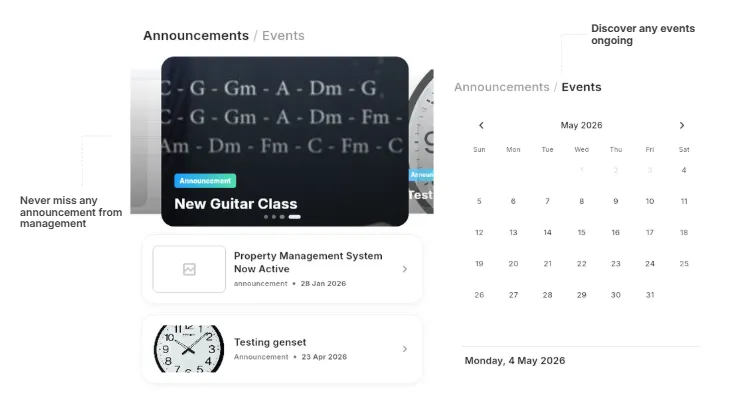
Management needs a fast way to reach every tenant at once — scheduled power outages, fire drills, or policy changes. A broadcast feature provides a centralized communication channel between management and tenants, making it easy to send notifications and announcements so that important information no longer gets buried in a WhatsApp group cluttered with unrelated chatter.
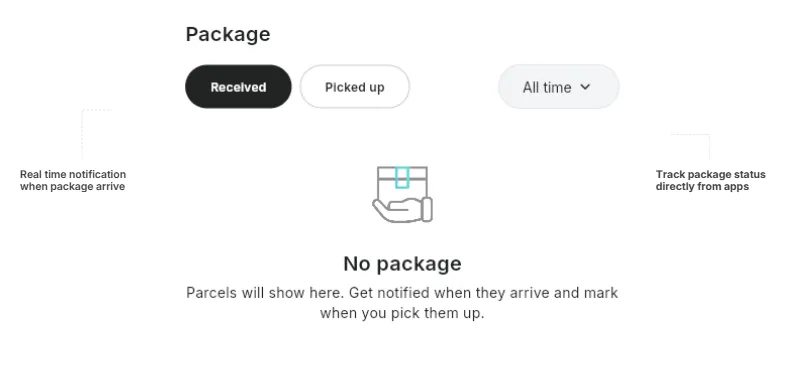
In the age of online shopping, the volume of packages arriving at an apartment building or office tower can reach dozens — even hundreds — per day. A digital package logging feature, complete with automatic arrival notifications and electronic proof of handover, drastically reduces the risk of "lost" packages like the one in our opening story.
For office buildings or apartments with tight security protocols, a digital work permit or visitor/vehicle exit-entry request feature speeds up the administrative process while creating a clear audit trail — who approved it, when, and for what purpose.
Tenants frequently lose their physical lease copies. With a tenant portal, all documents — leases, addendums, payment receipts — are stored neatly and can be downloaded anytime without needing to contact management.
An in-app chat or ticketing feature ensures every conversation between tenant and management is properly documented, unlike communication through personal WhatsApp messages that can easily get lost or overlooked during staff turnover.
Whether it's a payment due date reminder, a complaint status update, or a facility booking confirmation, timely push notifications keep tenants informed without needing to repeatedly open the app just to check manually.
Tenants should ideally be able to download their own payment history anytime — this is especially useful for personal tax reporting or expense reimbursement for commercial tenants.
The more payment methods supported — from e-wallets to bank transfers to credit cards — the lower the chance tenants delay payment due to technical friction with their preferred payment method.
Not every tenant is comfortable using a mobile app. A good tenant portal provides access through both a web browser and a mobile app, so tenants can freely choose how they want to access services.
Because this portal stores personal data and financial transaction history, data encryption, two-factor authentication, and role-based access control are non-negotiable features. A tenant data breach can seriously damage a property manager's reputation.
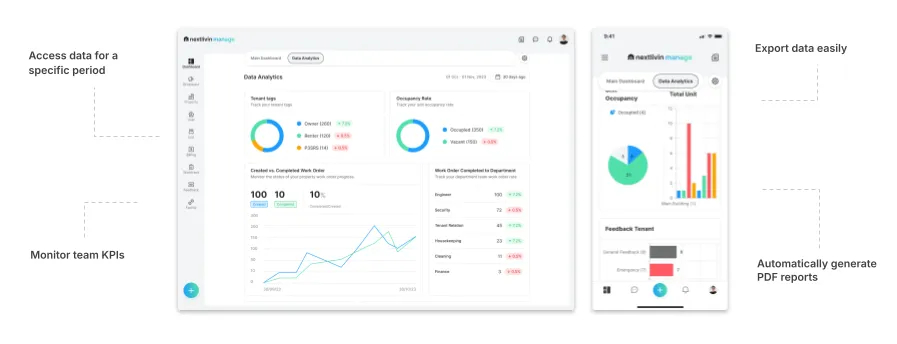
While technically a management-side feature, a dashboard showing portal usage rates, complaint response speed, and tenant payment trends helps management continuously measure how effective their service actually is — and serves as a benchmark for whether service standards meet tenant expectations.
| Aspect | Manual/Conventional System | Digital Tenant Portal |
|---|---|---|
| Complaint reporting | Phone/WhatsApp, easily missed | Logged in system, status trackable |
| Rent payment | Manual transfer, slow verification | Automated, integrated payment gateway |
| Announcements | WhatsApp group, easily buried | Centralized broadcast, well-documented |
| Package management | Manual logbook | Digital, automatic notifications |
| Lease documents | Physical, easily lost | Digital, accessible anytime |
| Audit trail | Virtually none | Complete and traceable |
Several property managers have started splitting their systems into two integrated sides: one for the internal management team, and one dedicated to tenants. This approach typically covers features like tenant complaints, work permits, visitor entry/exit permits, facility bookings, tenant requests, and billing — all within a single tenant app that's separate from the internal building management system, yet still connected to the same data. This model works well because tenants never have to see the internal complexity of the management system, while the management team retains full control over building operations data.
To put it simply: imagine a 500-unit apartment building transitioning from a manual system to a digital tenant portal. Previously, a single customer service staff member had to handle an average of 40-50 WhatsApp messages a day just for billing and complaint status questions. After switching to a tenant portal, most of those questions were answered automatically through the payment history and complaint tracking features — freeing staff to focus on cases that actually need human intervention, rather than answering "has my payment gone through yet?" for the 30th time in a single day.
Before deciding which app to use, it's worth considering the following:
What's the difference between a tenant portal and a tenant management system? A tenant portal is a specific module or section that faces tenants directly, while a tenant management system is the broader system that covers overall tenant management, including the internal administrative side for property management staff.
Is a tenant portal only useful for large buildings? Not at all. Even small to mid-sized properties can benefit significantly from a resident portal, particularly in reducing administrative workload and speeding up complaint response times.
How long does it take to implement a tenant portal in a building? It depends on the property's complexity, but initial implementation for small to mid-sized properties typically takes a few weeks, while larger buildings with more integrations may take longer.
Tenant portal features are no longer an optional add-on in property management software — in 2026, they're a baseline standard that determines how competitive a property manager is in the eyes of both prospective and existing tenants. From online payments and complaint tracking to facility booking and package management, every feature covered above plays a direct role in reducing manual workload while boosting tenant satisfaction.
If the building you manage still relies on a mix of WhatsApp, logbooks, and phone calls to serve tenants, now may be the time to consider a tenant management system with a full-featured tenant portal — not just for operational efficiency, but to retain tenants for the long run.

This Article is provided by Nextlivin. For more information about how Nextlivin can help manage your property efficiently, please visit our site.
In the modern property industry, tenant experience has become one of the key factors that determines the quality of residential and commercial buildings. Tenants are not only looking for comfortable facilities but also services that can simplify their daily activities.
One of the common needs in apartment, office, and residential property management is visitor management. Whether it is family members, friends, business guests, or external parties, every visit requires a system that provides security while still offering convenience for tenants.
However, many properties still rely on manual visitor processes, such as security desk registration, phone confirmations, or unintegrated communication methods. These approaches can create waiting times, inaccurate records, and difficulties for tenants when receiving guests.
In the digital era, visitor management requires a solution that combines security and convenience. With an integrated visitor system, tenants can manage guest visits more easily, while property management teams can improve building security control.
A visitor feature is not only about recording who enters a building but also about creating a more convenient experience for tenants while maintaining better security for property management.
One of the challenges tenants face is receiving unexpected guests.
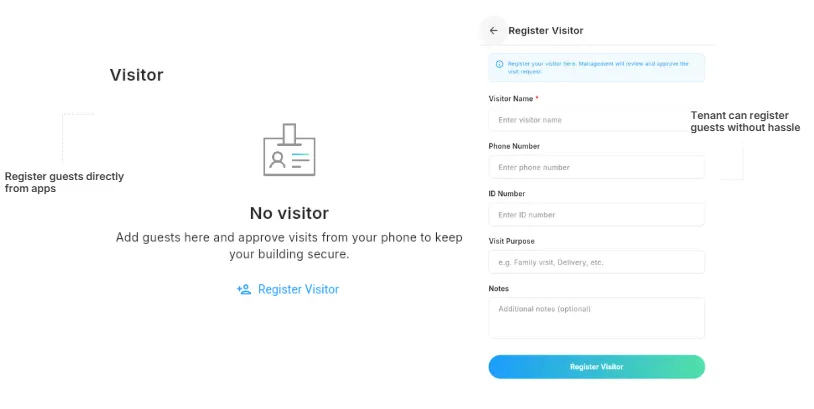
With a digital visitor feature, tenants can register their guests in advance without going through a long manual process.
Visitor information can be submitted before arrival, making the guest reception process faster and more convenient.
Manual visitor registration often takes more time and creates the possibility of inaccurate records.
With a digital system, visitor information can be stored automatically, allowing Security teams to perform verification more efficiently.
Security is one of the highest priorities in residential and office properties.
With properly recorded visitor data, management teams can monitor who enters and leaves the building area.
This helps create a safer environment for all tenants.
Today’s tenants are increasingly familiar with fast and practical digital services.
The convenience of managing visitors becomes one of the service improvements that can increase tenant satisfaction toward property management.
Communication between tenants and Security teams becomes more effective because visitor information is clearly available.
Security teams can process guest arrivals faster without needing repeated confirmations.

Nextlivin provides a Visitor feature that helps tenants and property management teams manage guest visits in a more convenient, secure, and structured way.
Through a digital system, visitor management no longer depends on manual registration but can be handled through one integrated platform.
Tenants can register guests before their arrival through the system.
Visitor details such as guest identity and visit purpose can be recorded more systematically, allowing faster verification processes.
Tenants can easily receive information related to guest visits.
This helps tenants maintain control over who enters their unit or property area.
Building Managers and Security teams can monitor visitor activities more effectively.
Stored visitor data helps improve security and simplifies operational evaluation processes.
All visitor histories can be properly documented.
This data can support security needs, operational reporting, and evaluation of building services.
With a faster and easier process, tenants no longer experience difficulties when receiving guests.
Nextlivin helps create a more modern, secure, and comfortable living experience.
The growth of technology in the property industry continues to increase the demand for digital services.
Today, tenants expect more practical experiences in their daily activities, including managing and receiving visitors.
Many modern apartments and buildings have started implementing digital visitor systems to improve security while providing better services for residents.
Visitor digitalization benefits not only tenants but also helps Security teams and Building Management operate more effectively through accurate and easily monitored data.
Properties that provide convenient digital services gain additional value in the eyes of tenants.

Visitor features have become an important solution for creating a more convenient and secure tenant experience.
With the right system, tenants can manage guest visits more easily, while property management teams can improve security and operational efficiency.
Through Nextlivin’s Visitor feature, visitor registration, visit monitoring, and visitor data documentation can be managed more systematically within one integrated system.
Because modern properties are not only about providing excellent facilities but also about creating convenience in every tenant activity.
With digital visitor management, tenant experiences become more practical, security improves, and property management becomes more professional.
This Article is provided by Nextlivin, for more information about how Nextlivin can help manage your property efficiently, please kindly visit our site.
Similar Article: The Importance of Visitor Management in Apartments and How to Do It Effectively
In the modern property industry, tenant satisfaction has become one of the most important factors determining the success of building management. Tenants no longer expect only complete facilities, but also require fast, transparent, and responsive services when facing problems.
However, one of the biggest challenges in apartment and residential building management is the inefficient complaint handling process. Tenants may need to contact multiple parties, wait too long for responses, or receive unclear information about the progress of their reports.
Unresolved complaints can reduce tenant comfort and create the perception that building management is not responsive enough.
In today’s digital era, tenants expect a more convenient service experience. They want to report problems easily, receive quick responses, and know that their complaints are being processed until the issues are fully resolved.
This is why a digital Property Management System like Nextlivin helps create a more effective communication process between tenants and building management teams.
For tenants, a complaint is not just a report—it represents a need that requires a real solution. Whether it involves facility damage, comfort issues, or specific requests, every complaint requires proper attention and follow-up.
With an integrated system, tenants can directly submit reports through one platform without searching for different department contacts.
Tenants can submit complaints anytime by providing detailed information about the issue, including location and supporting details.
Tenants can monitor whether their reports have been received, are being processed, or have already been completed.
By automatically forwarding information to the responsible team, problems can be handled faster and more efficiently.
When tenants see that every complaint receives proper attention and resolution, their trust in building management increases.
Good complaint management is not only about solving problems but also about creating a more comfortable living experience for tenants.

Nextlivin provides a Property Management System that helps tenants and building management teams create a more effective communication flow through integrated digital features.
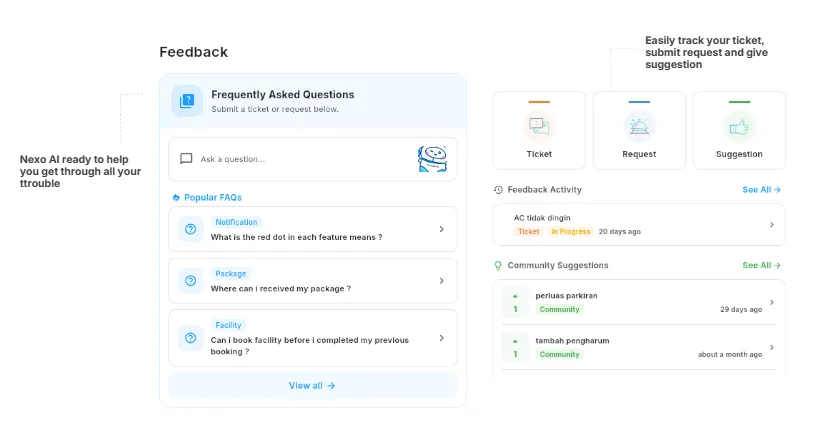
Through the Feedback feature, tenants can directly submit complaints or service requests through the application.
Tenants can explain the issue details, select the complaint category, and provide additional information to help management teams understand the situation faster.
Once a report is received, complaints can be assigned to the responsible team through the Worktrack feature.
Engineering teams can immediately receive tasks, inspect the issue, provide progress updates, and complete the work through a structured process.
Tenants no longer need to repeatedly contact building management to ask about their complaint progress.
Every status update can be monitored, allowing tenants to know that their issues are being handled.
All reports are documented within the system, allowing both tenants and management teams to review previous activities and completed tasks.
With faster and more organized processes, Building Managers can improve service standards and provide a better experience for all tenants.
Through Nextlivin, complaints are no longer recurring problems but become clear, fast, and professional service processes.
Digital transformation in the property industry continues to change tenant service standards. Today, tenants evaluate buildings not only based on available facilities but also on how effectively management responds to their needs.
Digital complaint management systems have become one of the solutions widely adopted by modern property managers. These systems allow the entire process—from complaint submission, task assignment, to resolution—to be monitored more transparently.
This approach helps create stronger relationships between tenants and building management because communication becomes faster, clearer, and more reliable.

Complaints that are responded to quickly and resolved properly have a significant impact on tenant satisfaction.
With Nextlivin Property Management System, tenants can easily submit issues, monitor report progress, and receive solutions without complicated processes.
Through the integration of Feedback and Worktrack features, building management teams can ensure every complaint is handled by the right team with a more structured workflow.
Because a great tenant experience begins with how a building listens, responds, and solves every tenant need.
With Nextlivin, every complaint becomes an opportunity to deliver better service.
This Article is provided by Nextlivin, for more information about how Nextlivin can help manage your property efficiently, please kindly visit our site.
Similar Article: Tenant Complaints Handled Quickly & Efficiently: No More Drama
In residential and commercial property management, tenant satisfaction is one of the most important indicators of service quality. One of the services tenants rely on most is the ability to report issues related to building facilities, individual units, or the surrounding environment.
Unfortunately, many tenants still need to contact multiple departments, send messages through different communication channels, or even visit the management office in person just to submit a complaint. These lengthy processes often result in delayed responses, incomplete information, and limited visibility into the progress of reported issues.
As digital technology continues to transform the property industry, tenants now expect complaint reporting to be faster, simpler, and more transparent. Modern Property Management Systems address these expectations by providing digital reporting features that can be accessed anytime through a single application.
For tenants, an efficient complaint process is not only about convenience—it also provides confidence that issues will be handled promptly and professionally.
Tenants can submit complaints whenever they need, without waiting for management office hours.
Everything can be completed directly through the application, making the reporting process faster and more convenient.
Tenants can include detailed descriptions, locations, and supporting photos to help the management team better understand the issue.
Tenants can monitor whether their complaint has been received, is currently being processed, or has already been resolved.
All complaint records are stored in one centralized system, making it easy for both tenants and management to review previous reports whenever necessary.
With a streamlined reporting process, tenants no longer have to worry about complicated procedures when reporting issues.

Nextlivin's Feedback feature is designed to provide tenants with a faster, easier, and more transparent way to submit complaints.
Tenants simply open the application, choose the appropriate complaint category, provide the necessary information, and submit the report without complicated procedures.
Visual documentation helps engineering and property management teams understand problems more quickly, enabling faster and more accurate resolutions.
Tenants can monitor the progress of every report without repeatedly contacting the management office.
Every submitted complaint is securely stored, allowing tenants to review previous reports whenever needed.
Each complaint can be automatically forwarded to the appropriate team through the Worktrack feature, ensuring faster task assignments, better coordination, and more efficient issue resolution.
Through this integrated system, tenants enjoy a smoother service experience while property management teams benefit from improved operational efficiency.
Digital transformation in the property industry has encouraged more Building Managers to provide self-service features through dedicated mobile applications.
Digital complaint management has become one of the most valuable services because it improves communication between tenants and property management teams. Besides accelerating response times, digital platforms also provide greater transparency throughout the complaint resolution process.
This trend reflects the growing importance of tenant experience as a key priority in modern Property Management.

An easy and efficient complaint process is an essential part of creating a positive living and working experience within a property.
With a simple digital reporting system, tenants can quickly submit issues, monitor their resolution status in real time, and have confidence that every report is properly documented.
Through the integrated Feedback and Worktrack features, Nextlivin simplifies complaint management by providing a faster, more organized, and more transparent reporting experience. There is no need to switch between multiple communication channels or contact different departments—everything can be managed within a single platform.
Because exceptional property management begins with effective communication. With Nextlivin, submitting complaints becomes easier, issue resolution becomes more organized, and the overall tenant experience becomes significantly better.
This Article is provided by Nextlivin, for more information about how Nextlivin can help manage your property efficiently, please kindly visit our site.
Similar Article: Complaint Submission Using Forms in Apartments
In today's digital world, people expect everyday services to be fast, simple, and hassle-free. This expectation also applies to residential property management, especially when it comes to paying monthly building bills.
Unfortunately, many residents still experience lengthy payment procedures. They may need to fill out forms, manually submit payment receipts, wait for confirmation, or contact the management office whenever an issue arises.
For residents with busy lifestyles, these unnecessary steps consume valuable time and create frustration. That's why a simple, fast, and fully integrated digital billing system has become an essential feature of modern residential communities.
Monthly bill payments are recurring tasks. The easier the payment process, the more convenient and enjoyable the living experience becomes.
Residents shouldn't have to spend unnecessary time completing routine payments.
With just a few simple steps, monthly bills can be paid within minutes.
Residents no longer need to wonder whether their payment has been received. Payment status is updated directly within the system.
Every transaction is securely stored, allowing residents to access their payment records anytime they need them.
Digital payment processing minimizes administrative mistakes, lost receipts, and manual verification issues.
When billing becomes simple and efficient, residents can focus on enjoying their home instead of dealing with unnecessary administrative work.

Nextlivin's Billing Management solution is designed to deliver a seamless, convenient, and user-friendly payment experience for every resident.
Residents can view detailed billing information directly through the application without contacting the management office.
Bills can be paid through an integrated digital platform, eliminating time-consuming manual processes.
Once a payment is successfully completed, the billing status is updated promptly, providing immediate confirmation without manual follow-up.
All payment records are stored securely within one account, making it easy for residents to review previous transactions whenever necessary.
Automatic notifications remind residents before payment due dates, helping them avoid late payments.
A fast, transparent, and convenient billing system enhances the overall living experience while reducing administrative hassles.
With Nextlivin's Billing Management system, paying monthly building bills becomes as simple as a few quick taps.
Resident experience has become a major focus in today's property management industry. Modern residential communities are investing not only in better facilities but also in digital services that improve convenience and satisfaction.
Integrated digital payment systems are increasingly being adopted because they streamline transactions, improve transparency, reduce administrative workloads, and create a smoother experience for both residents and property management teams.
As expectations for digital services continue to grow, simplified billing solutions are becoming a key feature of professionally managed residential properties.

Paying your monthly building bills should never be complicated or time-consuming.
With a modern, integrated platform, residents can view outstanding bills, make secure digital payments, receive instant confirmation, and access their complete payment history—all in one place.
Through its Billing Management feature, Nextlivin provides a fast, transparent, and hassle-free payment experience. There's no need for paperwork, manual payment confirmations, or worrying about misplaced receipts.
Because modern living is about more than quality facilities—it's about making everyday tasks simpler. With Nextlivin, paying your building bills is truly fast, effortless, and completed in just a few taps.
This Article is provided by Nextlivin, for more information about how Nextlivin can help manage your property efficiently, please kindly visit our site.
Similar Article: Digital Billing: A Modern Solution to Billing Challenges in Residential Building Management
The resident experience is shaped by more than just an apartment's location, architectural design, or amenities. One of the most influential factors is the quality of property management.
Today's residents expect services that are fast, transparent, and easily accessible. They want to pay bills online, submit maintenance requests without hassle, reserve shared facilities conveniently, and receive important announcements in real time.
In contrast, apartment communities that still rely on manual processes often struggle with slower service delivery, fragmented communication, and inefficient operational workflows.
This is why more residential properties are adopting integrated Property Management Systems like Nextlivin to deliver a better living experience while improving operational efficiency.
Even when two apartment buildings offer similar facilities, the overall resident experience can be dramatically different depending on how the property is managed.
Properties that still rely on manual administration often present several common challenges for residents:
These challenges can reduce resident satisfaction, even when the property's physical facilities are well maintained.
With an integrated Property Management System, residents enjoy a far more convenient and connected living experience.
Using a single application, residents can review invoices, make payments, submit maintenance requests, monitor complaint resolution, reserve shared facilities, receive building announcements, register visitors, and track package deliveries.
Every interaction becomes more transparent, reducing uncertainty while improving communication between residents and property management.

Nextlivin provides a comprehensive suite of features that simplify communication and strengthen the relationship between residents and property management teams.
Residents can easily access invoices, monitor payment status, and complete payments through a more convenient and transparent billing process.
Maintenance requests and resident feedback are digitally recorded, allowing residents to track the progress of every submitted request.
Reserve shared facilities through an organized digital scheduling system that minimizes booking conflicts.
Simplify guest registration while supporting a safer and more secure residential environment.
Receive timely notifications about incoming deliveries, making package collection easier and more efficient.
Stay informed with important building announcements delivered directly through one centralized communication platform.
Management teams gain real-time operational visibility, enabling faster response times and improved service quality for residents.
By integrating every resident service into one intelligent platform, Nextlivin creates a more convenient, transparent, and modern apartment living experience.
Resident digital services continue to become a defining trend in the property management industry.
Apartment communities around the world are embracing Smart Living concepts by implementing cloud-based Property Management Systems that streamline communication, automate operational processes, and improve resident engagement.
As digital expectations continue to rise, residents increasingly value properties that offer convenient self-service capabilities, transparent communication, and responsive management through integrated technology.
Buildings that invest in digital property management solutions today are better positioned to improve operational efficiency, strengthen resident satisfaction, and remain competitive in an evolving residential market.

The difference between an apartment managed through an integrated Property Management System and one that still relies on manual processes extends far beyond operational efficiency—it directly influences the resident experience every day.
With Nextlivin, residents can conveniently manage billing, submit maintenance requests, reserve facilities, receive announcements, register visitors, and monitor package deliveries through one unified platform.
At the same time, Building Managers gain centralized operational tools that improve coordination, accelerate service delivery, and support better decision-making.
Because modern apartment living is no longer defined solely by comfortable buildings—it is defined by intelligent services, seamless communication, and technology that enhances every aspect of the resident experience.
That is the experience Nextlivin is designed to deliver.
This Article is provided by Nextlivin, for more information about how Nextlivin can help manage your property efficiently, please kindly visit our site.
Shared facilities have become one of the most valuable amenities in modern residential communities. Function rooms, swimming pools, fitness centers, sports courts, coworking spaces, and other common facilities significantly enhance residents' quality of life.
However, the booking process often becomes a source of frustration. Residents inquire about availability, wait for confirmation, and sometimes assume their reservation has been secured—only to discover that the schedule was never properly recorded or conflicts with another booking.
These situations create uncertainty, inconvenience, and disappointment, ultimately affecting the overall resident experience.
In today's digital era, residents expect a booking process that is fast, transparent, and reliable. Property management teams also need an efficient system to organize reservations without unnecessary administrative work.
This is where Nextlivin provides a smarter solution by transforming facility booking into a seamless and worry-free experience.
Many booking problems occur because reservations are still handled manually or through multiple disconnected communication channels.
When bookings are recorded in notebooks, spreadsheets, or messaging applications, reservation details can easily be overlooked or misplaced.
Residents often need to wait for management staff to manually verify availability before receiving confirmation.
Without a centralized booking platform, multiple residents may unintentionally reserve the same facility for the same time slot.
Residents frequently have no visibility into facility availability, reservation status, or booking policies.
When residents cannot rely on the booking process, they lose confidence in property management and may hesitate to use shared facilities in the future.
Although facility booking appears to be a simple operational task, inefficient reservation management can significantly impact the overall resident experience.

Nextlivin's Facility Booking feature simplifies the reservation process for both residents and property management teams through one integrated platform.
Residents can reserve facilities directly through the application without making phone calls or contacting multiple departments.
Facility availability is managed within one centralized system, reducing scheduling conflicts and improving reservation accuracy.
Residents can easily see whether their booking request is pending, approved, or declined, providing greater certainty throughout the process.
Property management teams can monitor, review, approve, and organize every reservation from a single dashboard.
Every booking is securely recorded, making reporting, auditing, and operational planning much easier.
Residents enjoy greater convenience, faster responses, and increased confidence knowing their reservations are properly managed.
With Nextlivin, facility booking is no longer confusing or uncertain. Residents receive clear confirmation, while management gains better operational control through one integrated system.
The global property management industry is increasingly focused on improving the digital resident experience.
Residents now expect more than premium facilities—they also expect simple, convenient, and transparent access to those facilities.
As a result, more residential communities are implementing digital reservation systems alongside resident communication, billing, visitor management, and other smart property services.
Digital facility booking has become an important component of modern residential living because it directly influences convenience, operational efficiency, and resident satisfaction.
Properties that provide a fast, transparent, and reliable reservation experience are more likely to strengthen resident trust and improve long-term retention.

Booking shared facilities should be simple, convenient, and stress-free.
When reservation processes are slow, unclear, or disorganized, residents become frustrated and lose confidence in property management.
Nextlivin solves these challenges through its integrated Facility Booking feature, allowing residents to submit reservation requests digitally while giving management complete visibility into schedules, approvals, and facility usage.
The result is a more organized booking process, fewer scheduling conflicts, and a significantly better experience for everyone involved.
Because exceptional resident experiences are not created solely by providing excellent facilities—they are created by making those facilities easy, transparent, and enjoyable to use.
That is exactly what Nextlivin helps property management teams achieve.
This Article is provided by Nextlivin, for more information about how Nextlivin can help manage your property efficiently, please kindly visit our site.
In today's property management industry, the success of a residential building is no longer measured solely by its architecture or premium facilities. The overall resident experience has become one of the most important factors influencing resident satisfaction, loyalty, and property reputation.
Modern residents expect more than just a place to live. They want fast services, transparent communication, simple administrative processes, and convenient digital access to everything they need.
At the same time, Building Managers are expected to deliver exceptional service to hundreds or even thousands of residents while managing limited operational resources. Without an integrated property management system, service requests can become delayed, communication fragmented, and daily operations increasingly difficult to manage.
This is why adopting a modern Property Management System like Nextlivin has become essential for delivering a seamless, efficient, and resident-centered living experience.
Residents today value convenience, transparency, and responsiveness throughout their daily living experience.
Some of the most common expectations include:
Residents want to receive important announcements instantly without relying on notice boards or searching through multiple communication channels.
When reporting maintenance issues or service requests, residents expect their concerns to be acknowledged, tracked, and resolved with clear status updates.
Residents appreciate a billing system that is easy to understand, simple to access, and transparent throughout the payment process.
Booking shared amenities such as function rooms, sports facilities, or community spaces should be quick, convenient, and free from scheduling conflicts.
With online shopping becoming part of everyday life, residents want immediate notifications when their deliveries arrive at the property.
Meeting these expectations is no longer considered an added benefit—it has become a fundamental part of delivering outstanding residential services.

Nextlivin provides an integrated digital platform that strengthens communication between residents and property management while making daily services more efficient.
Residents can submit complaints or suggestions directly through the application and monitor their resolution progress in real time.
Billing information is presented clearly, allowing residents to view charges, payment history, and outstanding balances with ease.
Residents can reserve shared facilities anytime through a simple and transparent digital booking system.
Property management can instantly distribute important announcements and updates to all residents through one centralized platform.
Visitor registration becomes faster, safer, and more convenient, improving both security and the overall resident experience.
Residents receive timely notifications when packages have been received by the management office, making collection easier and more organized.
Service requests submitted by residents can be converted into work orders, allowing Building Managers to monitor progress and ensure faster response times.
Together, these integrated features create a smoother, more connected, and more satisfying living experience for every resident.
Across the global property industry, resident experience has become one of the key indicators of successful property management.
More property management companies are investing in digital technologies to improve communication, operational efficiency, and service quality.
Resident applications are no longer viewed as optional conveniences—they are becoming essential tools for strengthening relationships between residents and management while improving operational transparency.
As Smart Building and Smart Living concepts continue to evolve, digital resident platforms are expected to become the standard for modern residential communities.
Properties that prioritize resident satisfaction through technology are better positioned to improve retention, strengthen their reputation, and remain competitive in an increasingly digital marketplace.

Resident satisfaction is determined not only by the quality of a building but also by the quality of the services residents experience every day.
When communication becomes easier, complaints are handled more efficiently, billing is simplified, facilities can be reserved effortlessly, and important information is always readily accessible, the overall living experience improves significantly.
Through its fully integrated features, Nextlivin empowers Building Managers to deliver faster, more professional, and more efficient services while reducing operational complexity.
Ultimately, satisfied residents are more likely to trust property management, renew their residency, and recommend the community to others.
Because exceptional resident experiences are never accidental—they are created through consistent service, operational excellence, and the right technology.
That is exactly what Nextlivin is built to deliver.
This Article is provided by Nextlivin, for more information about how Nextlivin can help manage your property efficiently, please kindly visit our site.


Dapatkan free trial untuk menggunakan Nextlivin selama 14 hari!
Enter contact details to access and download our report
Enter your contact details to access and download our report